


Cricket Betting Predictions Separate the Profitable from the Lucky
My first profitable cricket betting season, back in 2018, felt like a breakthrough. I finished the year up 12% on turnover and assumed I had cracked the code. The following year, using the same methods, I lost 8%. The difference was not that my second-year analysis was worse — it was that my first-year success had been inflated by variance, and I had mistaken luck for skill. That humbling experience forced me to build a proper prediction framework, one that could distinguish between genuine edges and random noise. Five seasons later, that framework is the single most valuable tool in my betting arsenal.
Cricket represents approximately 14% of all global sports betting activity, trailing only football and basketball. That volume means the market is reasonably efficient — casual opinions and gut feelings are not enough to beat it consistently. Prediction models give you a structured way to process information, quantify uncertainty, and identify the specific situations where your assessment diverges from the bookmaker’s pricing. Without a model, you are guessing. With one, you are making calibrated probability estimates that can be tested, refined, and improved over time.
Tipster Services, Algorithms, and DIY Models — the Prediction Landscape
The prediction ecosystem in cricket ranges from free social media tipsters to paid subscription services to proprietary algorithms built by professional syndicates. I have tried most of them at various points, and the landscape is exactly as uneven as you would expect.
Free tipsters on social media and forums are useful for one thing only: gauging public sentiment. Their actual predictions are worthless for long-term profitability because they face no accountability, publish selectively (promoting wins, ignoring losses), and rarely disclose their staking or return on investment over meaningful sample sizes. The rare exception is a tipster who publishes every bet with timestamps and full staking records over at least two seasons. I have found perhaps three such accounts in nine years of looking.
Paid tipster services charge monthly fees ranging from £20 to £200 and promise access to expert selections. Some are legitimate operations run by knowledgeable analysts. Many are not. The simplest test is to ask for independently verified results over at least 500 bets. If the service cannot or will not provide that, the subscription fee is the product — not the tips. I subscribed to two cricket tipster services in 2020. One produced a modest profit over six months; the other was catastrophically poor. Both charged similar fees and made similar claims.

Algorithmic prediction models — whether commercial tools or DIY spreadsheets — are where serious cricket bettors invest their time. The advantage of a model is consistency: it processes the same inputs in the same way every time, removing the emotional biases that distort human judgment. The UK cricket betting market generates around £52 million annually, and the share captured by model-driven bettors is disproportionately large because models enforce the discipline that most punters lack.
Building a Prediction Model That Earns Its Keep
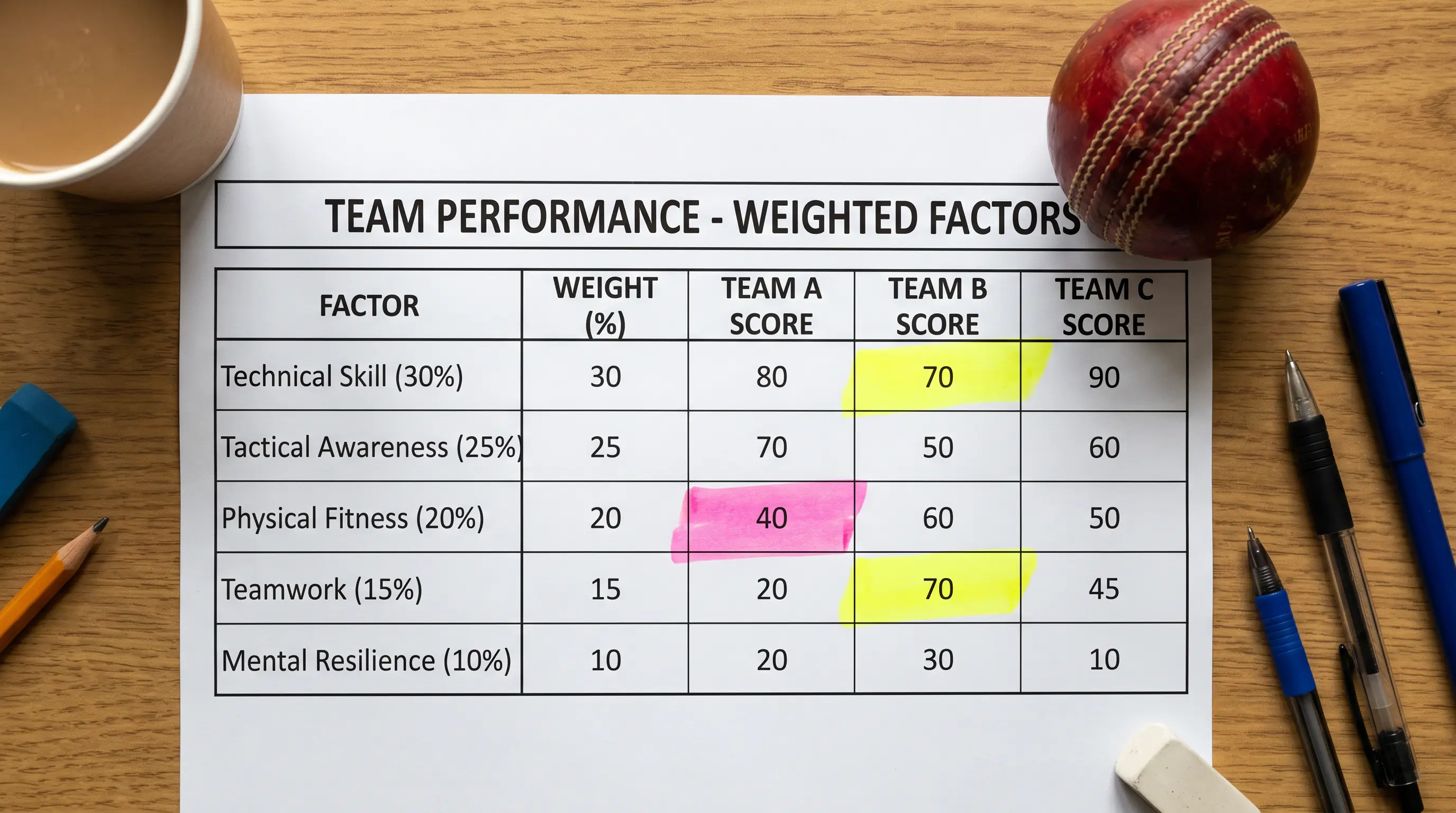
You do not need programming skills or statistical training to build a useful cricket prediction model. My current model runs in a spreadsheet and takes 20 minutes per match. It assigns probability estimates to outcomes based on five inputs: team strength rating (a rolling metric based on the last 12 months of results in the specific format), venue profile (average first-innings total, win/loss percentage for batting first versus second), conditions (pitch report, weather forecast, time of day for dew considerations), squad composition (key player availability, bowling attack balance), and market position (where the odds sit relative to my estimate).
Each input produces a score for each team. Team strength contributes 30% of the overall estimate, venue profile 25%, conditions 20%, squad composition 15%, and market position 10%. The weighted total for each team converts into an implied probability, which I compare to the bookmaker’s price. If my model gives a team a 55% chance of winning and the bookmaker prices them at 2.10 (implying 47.6%), the 7.4 percentage point gap signals potential value. I only bet when the gap exceeds 5 percentage points, which filters out marginal situations where the edge may be illusory.

The key insight I wish someone had shared earlier is that the model’s value lies not in its accuracy for individual matches but in its consistency across hundreds of bets. Any single prediction can be wrong. Over 200 or 300 bets, a well-calibrated model with a genuine edge will produce a positive return — and the record of those bets will tell you which inputs are contributing value and which are noise. I review my model’s performance every 100 bets and adjust the input weightings based on what the statistical evidence actually shows.

Calibration, Sample Size, and Knowing When Your Model Is Broken
The most dangerous period in a model’s life is the first 50 bets. If you hit a winning streak, you will overestimate the model’s accuracy and increase your stakes prematurely. If you hit a losing streak, you will abandon a potentially sound model before it has had a chance to prove itself. Both reactions are wrong. Fifty bets is not a meaningful sample in cricket betting — the variance is too high and the edge per bet is too small for short-term results to be informative.
I evaluate my model on rolling 200-bet windows. If, after 200 bets, the model is showing a positive return on investment of at least 3%, it is working and I continue. If the ROI is between 0% and 3%, the model may be working but the edge is marginal, and I look for ways to sharpen the inputs. If the ROI is negative after 200 tracked bets, something is fundamentally wrong — either the inputs are poorly weighted, the data sources are unreliable, or the market has adjusted to the patterns the model was exploiting.
Calibration testing is a simple sanity check that most bettors skip. Take every match where your model assigned a win probability between 60% and 70% to one team. Did that team actually win roughly 60 to 70% of those matches? If your “65% probability” selections are winning only 50% of the time, your model is systematically overconfident. If they are winning 75% of the time, your model is underconfident and you are leaving money on the table by not staking more aggressively. Perfect calibration is impossible, but tracking it reveals whether your model’s probability estimates are directionally honest.
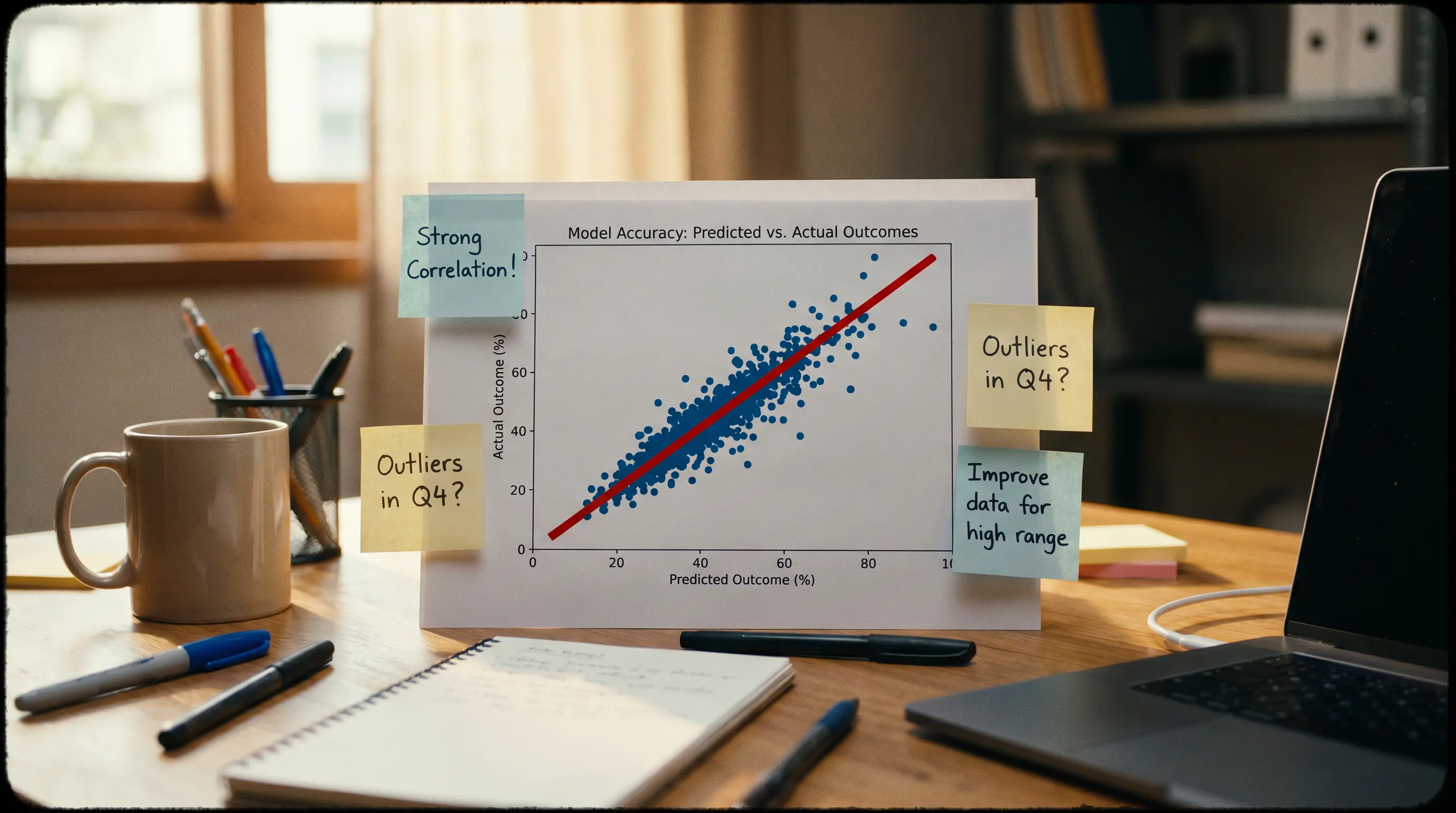
One pattern I have noticed across nine years is that models decay. A model that was profitable in 2022 may not be profitable in 2026 because the market adapts. Bookmakers improve their pricing, public bettors become more data-literate, and the patterns your model exploited become less reliable. The solution is continuous refinement — not wholesale rebuilds, but incremental adjustments to input weightings and data sources based on ongoing performance tracking. The bettors who build one model and never touch it again are the ones who quietly drift from profitable to breakeven to losing.

Cricket Betting Predictions — Questions Answered
Articles
Written by the editors at cricketbettipsonline.com.
