


Cricket Matched Betting Uses Bookmaker Promotions to Guarantee a Return
I started matched betting in 2018 as a side project, and within four months I had extracted over £1,200 from sign-up offers alone. No guesswork, no prediction, no risk. Matched betting is the closest thing to a free lunch in the betting world, and cricket — with its dense tournament schedule and frequent promotional offers — is one of the best sports to do it with.
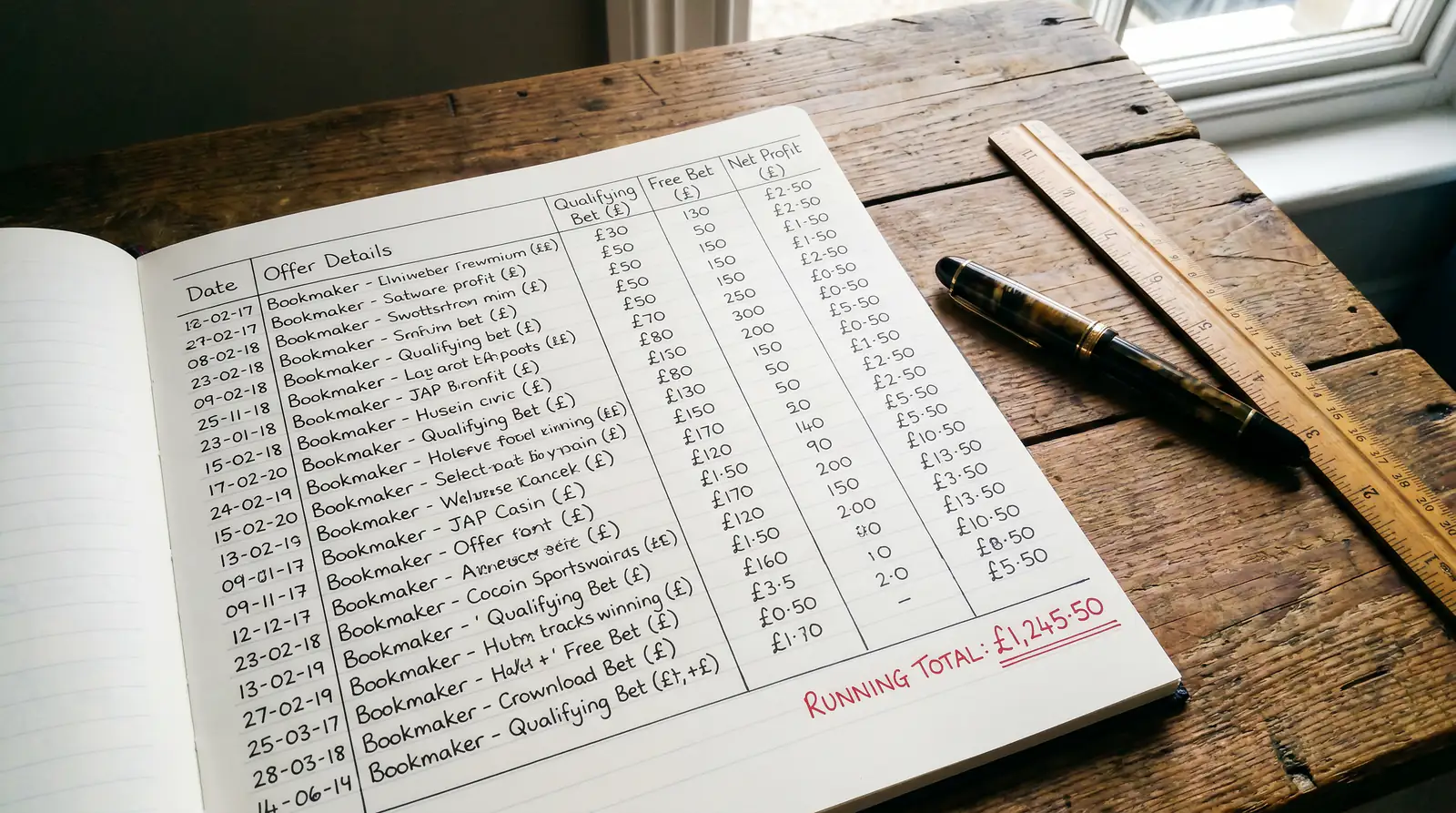
UK punters place roughly 290 million online sports bets every single month. A fraction of those bets are placed by matched bettors who have no opinion on who wins the match — they are simply converting bookmaker promotions into guaranteed profit by covering every possible outcome. The method is legal, transparent, and mathematically watertight. It is also time-limited, because bookmakers eventually restrict accounts that consistently extract value from promotions without generating conventional betting revenue.
This guide explains how matched betting works, why cricket offers particularly good opportunities, and what the realistic limitations look like.
How Matched Betting Works: The Back-Lay Principle
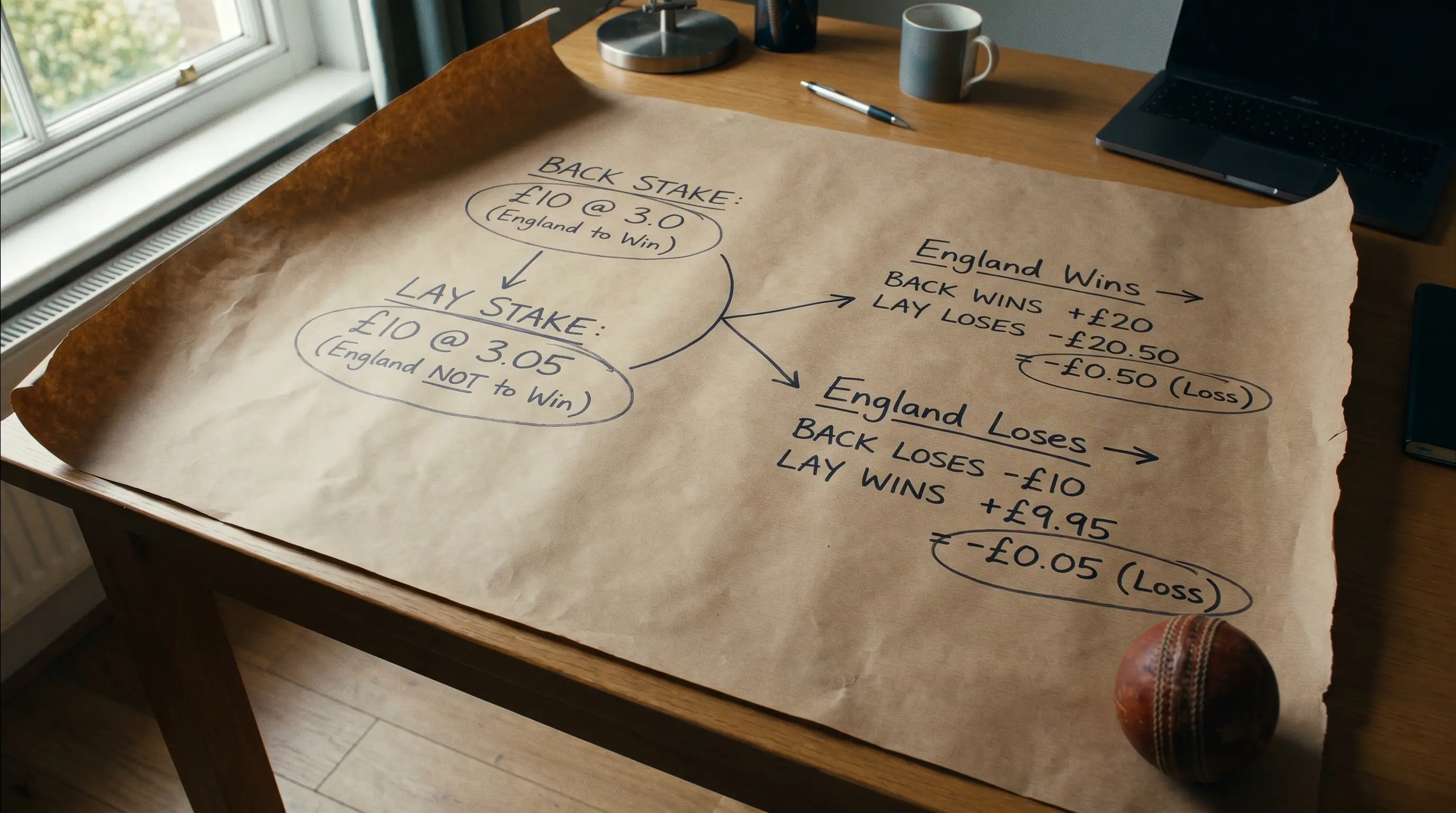
Matched betting rests on a simple mechanism: you place a back bet with a bookmaker using a free bet or promotional offer, and simultaneously place a lay bet on a betting exchange to cover the opposite outcome. Whichever way the match goes, one bet wins and the other loses, and the net result is a small guaranteed profit derived from the free bet’s value.
Here is a concrete example. A bookmaker offers a £20 free bet on cricket. You use that free bet to back Team A at odds of 3.00 on the bookmaker. Simultaneously, you lay Team A at 3.10 on the exchange. If Team A wins, the bookmaker pays you £40 in profit (free bet returns are stake-not-returned), and the exchange lay bet costs you approximately £42 in liability — a small loss. If Team A loses, the bookmaker free bet returns nothing, but the exchange lay bet wins you approximately £19.50 after commission. In both scenarios, you come out roughly £17 to £19 ahead after accounting for the exchange commission and the qualifying bet cost.
Online sports betting now represents roughly 75% of the global market, growing at 10.3% annually, and the competition between operators for new customers drives a constant stream of promotional offers that matched bettors can exploit. The key is to execute every step precisely: the back and lay odds must be as close together as possible to minimise the qualifying loss, and the free bet must be placed on selections with reasonable exchange liquidity so your lay bet gets matched.
Cricket is ideal for matched betting because the markets are binary in most cases — one team wins or loses — and exchange liquidity on major tournaments is strong enough to ensure tight back-lay spreads.
Why Cricket Offers Unique Matched Betting Opportunities
Most matched betting guides focus on football, but cricket has structural advantages that football lacks. First, the cricket calendar is relentless. The IPL runs for two months, The Hundred for five weeks, the T20 Blast overlaps with international tours, and bilateral series fill the gaps. Bookmakers run promotional offers tied to each of these events — “bet £10 on any IPL match, get £10 free bet” is a typical format — and the density of fixtures means you can cycle through offers rapidly.

Second, cricket match-winner markets have exactly two outcomes in limited-overs formats (ties are settled by Super Overs), which simplifies the back-lay calculation. Football has three outcomes — home win, draw, away win — which means you either need to lay two outcomes or find markets where the draw is unlikely. Cricket eliminates that complexity entirely in T20 and ODI matches.
Third, major cricket tournaments generate enough exchange volume to keep back-lay spreads tight. An IPL match between two popular franchises might have six or seven figures of exchange liquidity on the match-winner market, which means you can match a lay bet instantly at a price very close to the back odds. During quieter periods — County Championship matches, associate nation ODIs — liquidity drops and the spreads widen, making those fixtures less suitable for matched betting.

Account Restrictions, Limitations, and Realistic Expectations
Here is the part that most matched betting enthusiasts downplay: bookmakers are not stupid. They track customer behaviour with sophisticated algorithms, and accounts that consistently take promotional offers without placing conventional bets get restricted. Restriction typically means reduced maximum stakes, exclusion from promotional offers, or both. In my experience, a matched betting account lasts between three and twelve months before meaningful restrictions kick in.
The mitigation is to “mug bet” — place occasional conventional bets on the same account to make your activity pattern look like a normal recreational punter rather than a systematic promotion extractor. This extends account longevity but adds a small cost, because those mug bets carry the bookmaker’s standard margin. I budget 5 to 10% of my matched betting profit for mug bets, which typically delays restriction by several months.

Realistic returns from matched betting in cricket depend on the number of bookmaker accounts you have and the frequency of promotions. During the IPL season, I average two to three qualifying offers per week across multiple operators, each yielding £15 to £25. Outside major tournaments, the flow slows to one or two offers per week. Over a full year, a diligent matched bettor with accounts across most UK-licensed operators can realistically extract £1,000 to £2,500 in profit, with the majority coming during the IPL and English cricket season.
Matched betting is not a long-term strategy. It is a finite extraction exercise that works until the bookmakers restrict your accounts. But as a low-risk introduction to the mechanics of betting — understanding odds, using exchanges, calculating liability — it is genuinely valuable. Many of the skills I use in my day-to-day cricket betting analysis started with the discipline matched betting taught me.
Cricket Matched Betting — Questions Answered
Articles
Published by the cricketbettipsonline.com team.
