


Cricket Betting Statistics Turn Raw Numbers into Actionable Edges
In 2019, I started logging every variable I could find for each bet I placed — batting averages, bowling strike rates, venue histories, weather conditions, toss outcomes. By the end of that season, I had a spreadsheet with 47 columns and over 200 rows. Most of those columns turned out to be noise. But the five or six that mattered transformed my hit rate from roughly breakeven to consistently profitable. Statistics are powerful in cricket betting, but only if you know which ones to track and which to ignore.
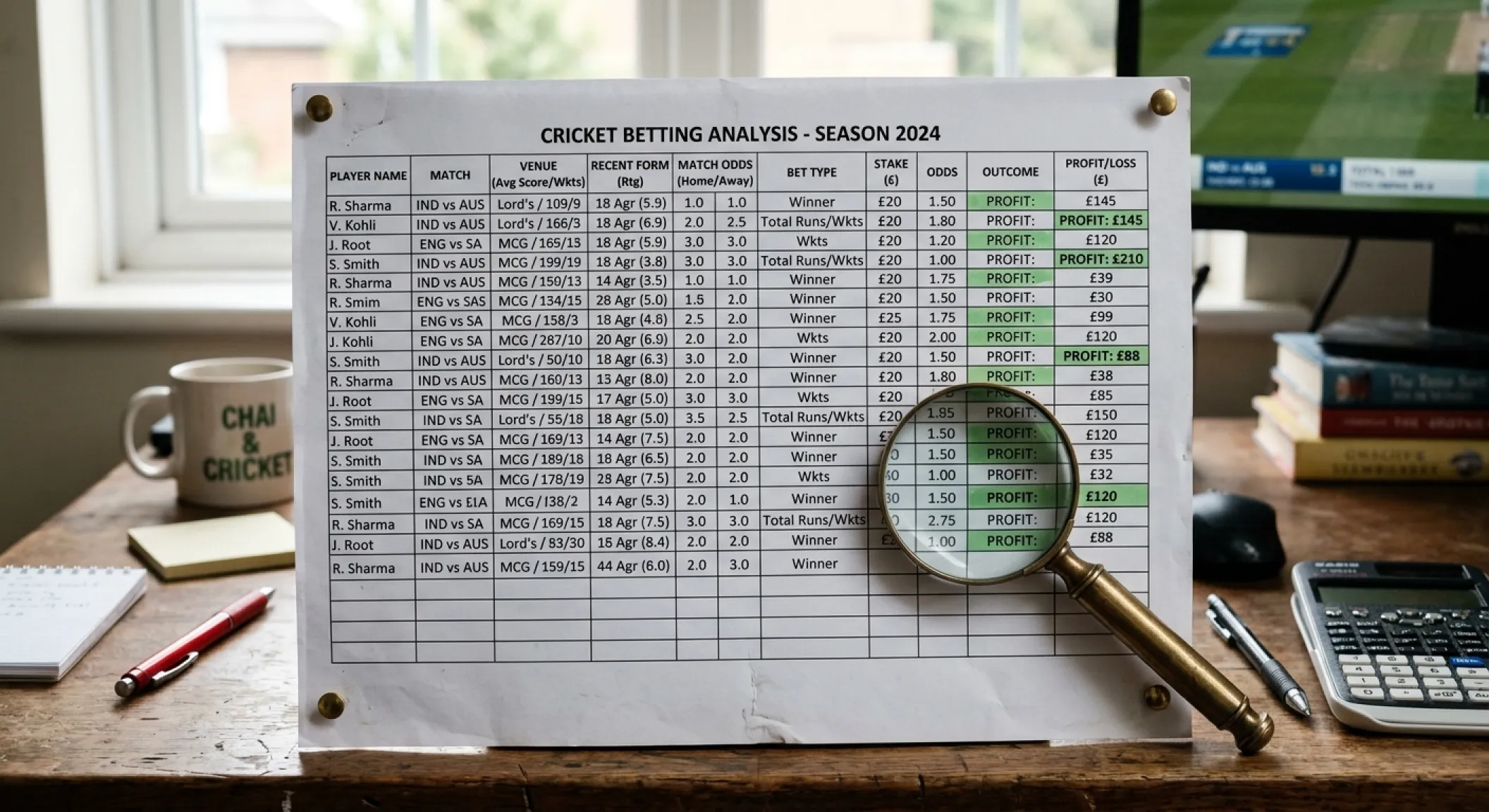
Cricket accounts for 14% of all global betting activity by sport, behind only football and basketball. That volume of action means bookmakers have sophisticated pricing models, and the only way to compete is with data of your own. The good news is that cricket is one of the most statistically rich sports on the planet — every ball generates multiple data points, every ground has decades of match history, and every player’s career is documented in granular detail across free public databases.
The challenge is curation: knowing where to find the data, which metrics actually predict outcomes, and how to translate numbers into betting decisions.
Key Data Platforms: ESPNcricinfo, CricViz, and Alternatives
ESPNcricinfo is the starting point for any cricket data analysis, and I still use it daily despite having access to more advanced tools. Its Statsguru feature lets you filter player and team records by format, opposition, venue, time period, and batting/bowling position. Want to know a batsman’s average against left-arm spin in T20 internationals at a specific ground over the past three years? Statsguru will give you that in seconds.

CricViz operates at a deeper level. It provides ball-tracking data, expected averages (xAVG), expected strike rates (xSR), and phase-specific performance breakdowns that are not available on ESPNcricinfo. The platform is used by several international cricket teams and franchise analysts, and its public-facing content — articles, social media infographics, and podcast appearances — offers insights that are directly applicable to betting. CricViz data is particularly valuable for identifying players whose underlying metrics are better or worse than their headline numbers suggest, which is exactly the kind of discrepancy that creates value bets.
The UK cricket betting market generates approximately £52 million annually, and the punters who capture a disproportionate share of the returns are the ones using data tools like these rather than relying on intuition or tipster recommendations. Beyond the two main platforms, there are several alternatives worth knowing. HowSTAT offers historical Test cricket data with unusual depth. Cricket Archive provides scorecards going back to the 19th century. And for those comfortable with data manipulation, the cricketdata package in R and Python allows you to pull ESPNcricinfo data directly into your own analytical models.
One platform I keep an eye on is the ICC’s own statistical database, which is underused by bettors but comprehensive for international fixtures. The limitation is that it does not cover franchise cricket — IPL, BBL, The Hundred — where much of the betting volume sits. For those leagues, ESPNcricinfo and CricViz remain the primary sources.

Which Statistics Actually Predict Match Outcomes
Not all cricket statistics are created equal for betting purposes, and I wasted an entire season learning that the hard way. Career batting averages, for example, are one of the worst predictors of individual match performance. They are heavily influenced by the era, conditions, and opposition quality across hundreds of innings, and they tell you almost nothing about how a player will perform in a specific match on a specific pitch.
The metrics I rely on are all context-specific. Venue-adjusted batting average — a player’s average at the ground where the match is being played — is far more predictive than career average. Recent form over the past 10 innings in the same format captures momentum and technical adjustments that career stats wash out. Phase-specific metrics — powerplay strike rate, middle-overs economy rate, death-overs boundary percentage — tell you how a player performs during the phase of the match that matters for your bet.
At the team level, the most useful statistic is win rate in the specific format over the past 12 to 18 months, adjusted for opposition quality. A team that has won 70% of its T20 matches is not equally strong against every opponent — and the quality-adjusted win rate gives a more honest picture. I also track first-innings par scores by venue, which feed directly into over/under analysis, and bowling attack economy rates by phase, which are essential for predicting match margins in handicap markets.
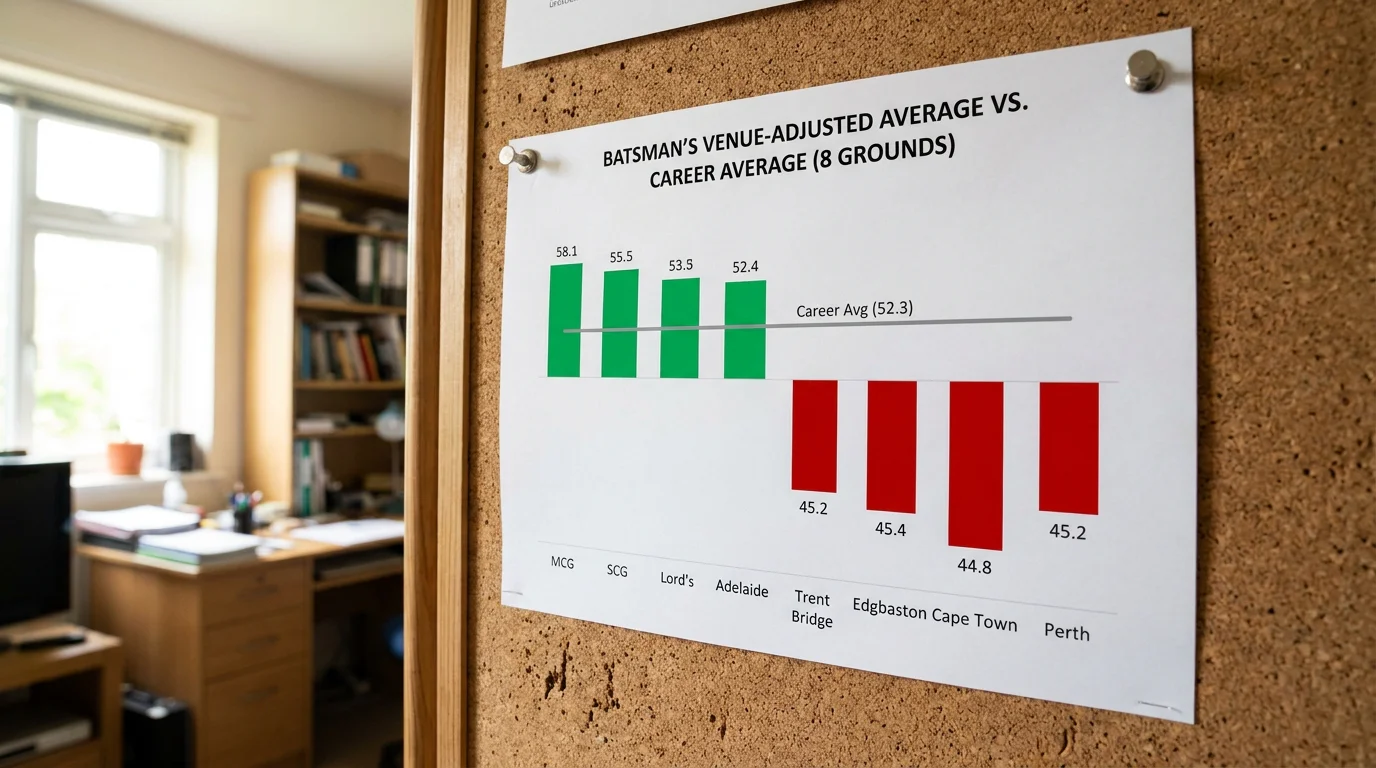
The statistics that do not predict outcomes well include: career statistics without format or venue filtering, head-to-head records between teams with significantly changed squads, and any metric based on fewer than 10 innings in the relevant context. Small sample sizes are the bane of cricket data analysis, and I treat any statistic drawn from fewer than 10 data points as directional at best.

From Data to Decision: Building a Simple Prediction Framework
You do not need a PhD in statistics to build a useful prediction model for cricket betting. My current framework runs on a spreadsheet and takes about 15 minutes per match to complete. It assigns weighted scores to five factors: team quality (recent format-specific win rate), venue profile (average first-innings total and win rate for batting first vs second), conditions (pitch report and weather forecast), squad composition (availability of key players, bowling attack balance), and market context (where the odds sit relative to my assessment).
Each factor gets a score from 1 to 5 for each team, and the weighted total produces a probability estimate that I compare to the bookmaker’s implied probability. When my estimate diverges from the market by more than 10 percentage points, I investigate further. If the divergence holds up after a deeper dive, that is a bet.
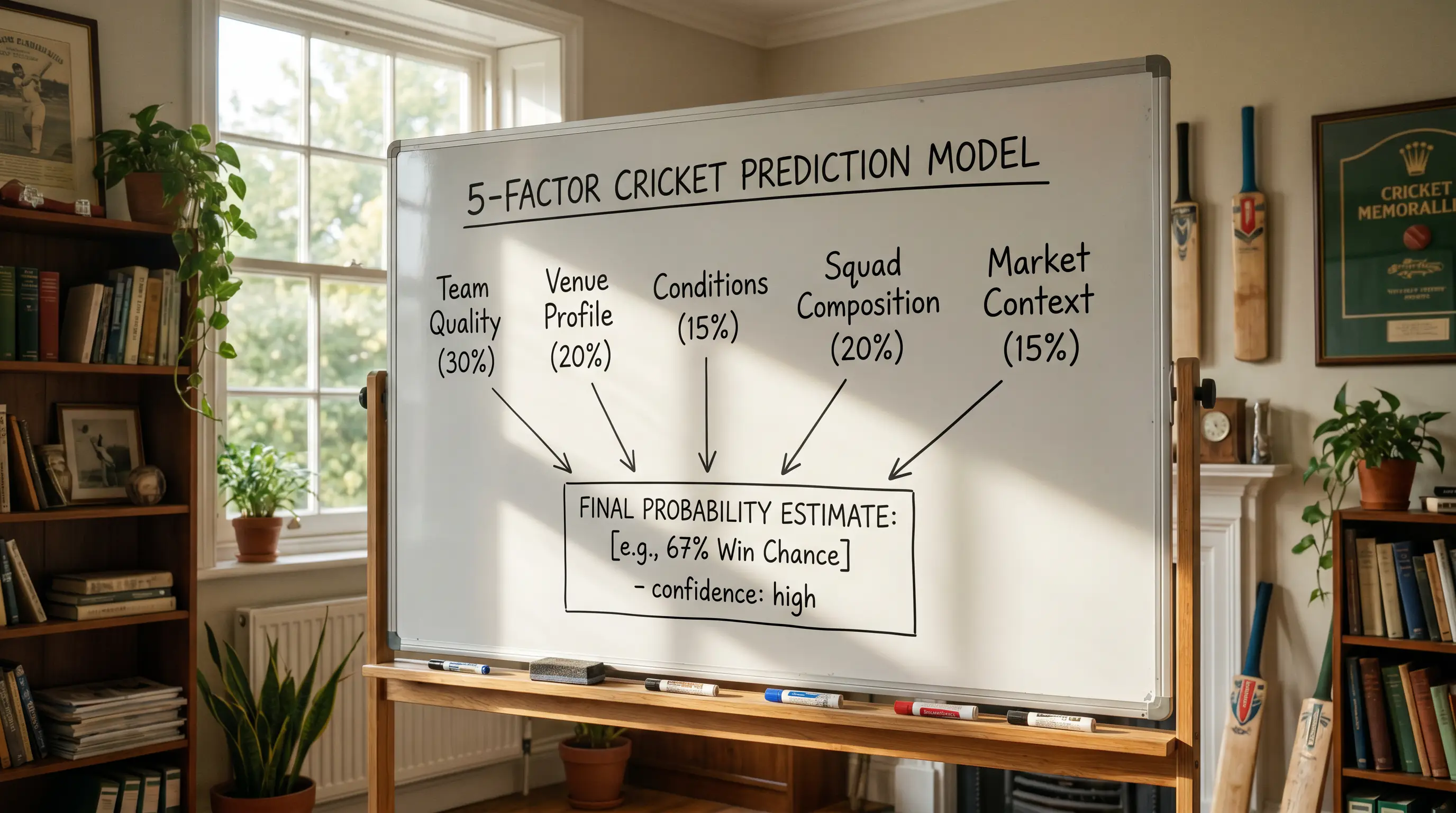
The framework is deliberately simple because complexity introduces overfitting — the tendency to build a model that explains past results perfectly but predicts future ones poorly. Every time I have tried to add a sixth or seventh variable to my model, the result has been worse, not better. Five factors, clearly defined and consistently applied, outperform a sprawling model that tries to account for everything. Start simple, track your results, and add complexity only when you have evidence that it improves your accuracy. That process has worked for me over nine years, and it will work for you too.
Cricket Betting Statistics — Questions Answered
Articles
Written by the editors at cricketbettipsonline.com.
