


Value Betting in Cricket Means Disagreeing with the Market — and Being Right
The bet that taught me more about value than any textbook was a losing one. I backed a team at 2.40 because my analysis said they had a 50% chance of winning — implied odds of 2.00. The price offered was higher than it should have been, the bet was mathematically correct, and the team lost. I placed the same type of bet another eleven times that season, and nine of them won. That is value betting in a sentence: individual results are noise, but the process is the signal.
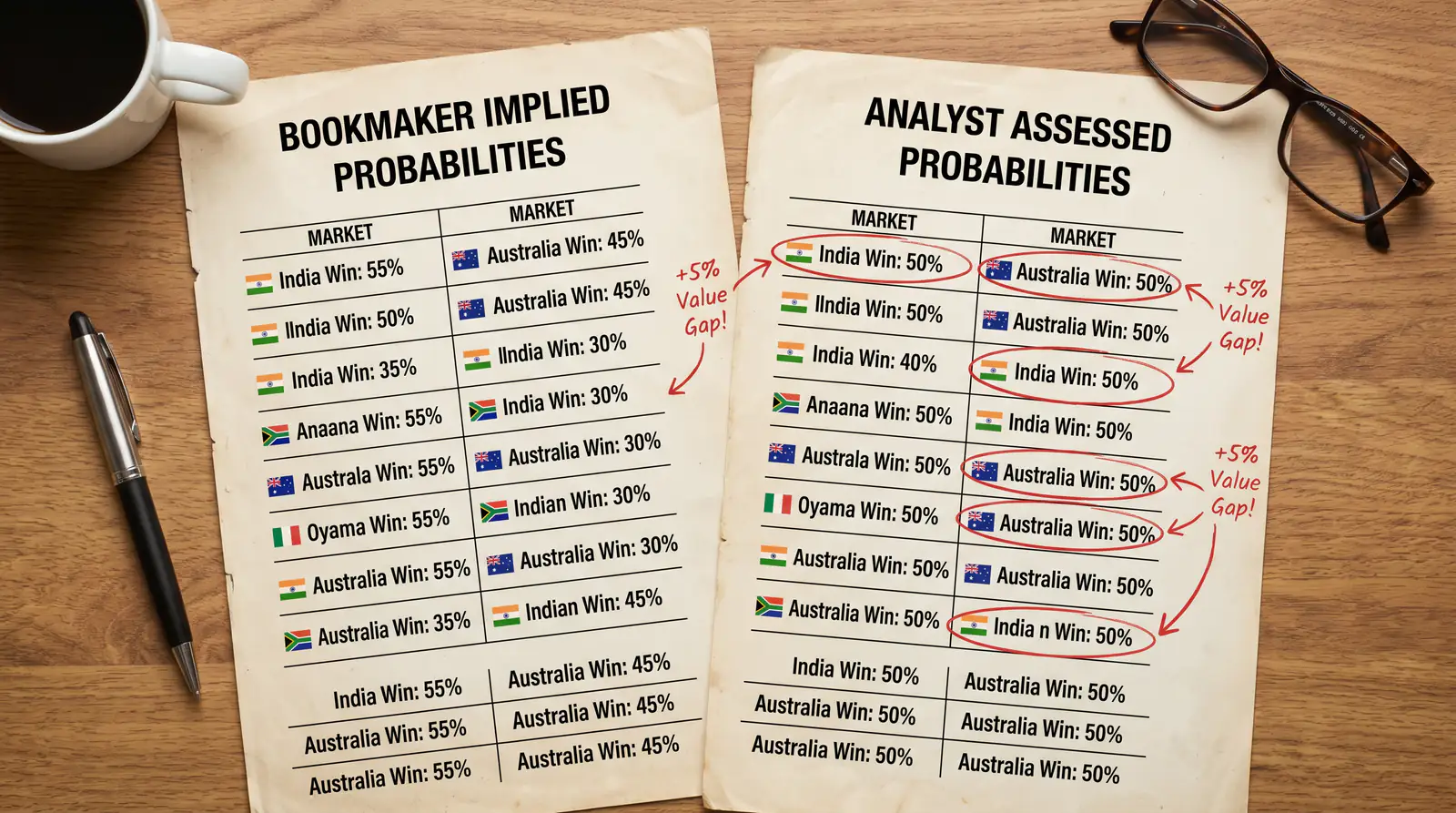
In a global cricket betting market valued at $14.45 billion in 2024 and growing at nearly 11% annually, bookmakers price thousands of cricket markets every day. They cannot get every one right. The gaps between their prices and the true probabilities are where value lives, and finding those gaps consistently is the single most important skill a cricket bettor can develop.
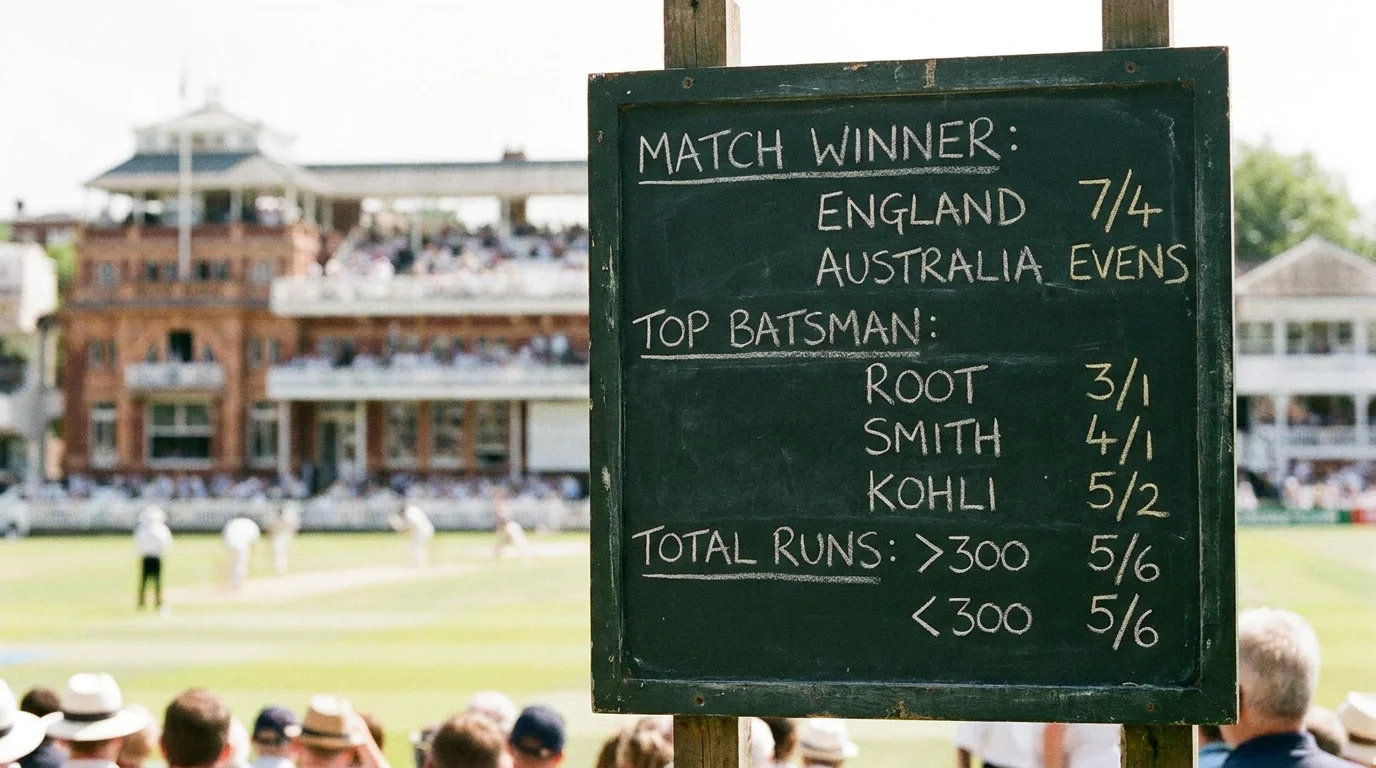
Value betting is not about predicting winners. It is about identifying situations where the odds you are offered exceed the actual probability of the outcome occurring. The distinction sounds academic, but it changes everything about how you approach cricket wagering — from the matches you bet on to how you evaluate your results.
How to Calculate Expected Value in a Cricket Market
Expected value is the concept that underpins every profitable betting strategy, and it is simpler than most people assume. The UK cricket betting market generates approximately £52 million annually — 2.2% of the online sports betting market — and every pound wagered within it is either positive or negative expected value.
The formula is straightforward. Multiply the probability you assign to an outcome by the potential payout, then subtract the probability of losing multiplied by the stake. If you estimate a team has a 45% chance of winning and the odds are 2.80 (decimal), the calculation looks like this: (0.45 x 2.80) – (0.55 x 1.00) = 1.26 – 0.55 = 0.71. A positive number means the bet has positive expected value. A negative number means it does not, regardless of how much you like the team or how likely you think they are to win.

The hard part is not the maths — it is the probability estimate. How do you decide that a team has a 45% chance rather than 40% or 50%? I use a combination of historical base rates, conditions-adjusted performance data, and format-specific modelling. For a T20 match, I start with each team’s win rate over the past 50 matches in the same format, adjust for venue, pitch, weather, and squad changes, and arrive at a probability range rather than a single number. If the bottom of that range still produces positive expected value at the available odds, the bet qualifies.
One critical point: value is relative to the price offered. A team with a 70% chance of winning at odds of 1.30 offers zero value because the implied probability (76.9%) exceeds the actual probability. The same team at 1.55 (implied 64.5%) becomes a strong value bet. Training yourself to evaluate the price independently of the expected outcome is the mental shift that separates value bettors from punters who simply back the team they think will win.
Markets and Situations Where Value Appears Most Often
After nine years of hunting for value in cricket, I have noticed that it clusters in specific places. The first is lower-profile matches. IPL finals, Ashes Tests, and World Cup knockouts attract huge public betting volumes, which means bookmaker algorithms have vast amounts of data to work with and the prices tend to be efficient. County Championship matches, T20 franchise league group stages, and bilateral ODI series between mid-ranked nations attract far less money, which means the odds are set with less precision and value opportunities are more frequent.

Player prop markets are another fertile ground. Pricing a match winner involves modelling two teams of eleven players in aggregate, which is a well-understood problem. Pricing a top batsman or top bowler requires individual-level modelling that accounts for batting position, bowling matchups, and phase-specific workloads. That granularity is harder to automate, and bookmakers frequently rely on name recognition and career averages rather than the context-specific metrics that drive actual performance. When a little-known all-rounder is batting at number three on a flat pitch but priced as though he is batting at number seven, the value is obvious to anyone who checks the team sheet.
The third cluster is post-toss adjustment. I have already discussed how the market often overreacts to the toss result, but it bears repeating here because the value mechanism is so clean. If the odds move by 15% after the toss and the actual toss advantage is 2 to 5%, the market has created a 10% window of mispricing that you can exploit systematically.

Common Mistakes When Hunting for Value Bets
The most common mistake is confusing a long price with a value price. An underdog at 8.00 is not automatically a value bet just because the potential payout is large. If their actual probability of winning is 8% (implied fair price 12.50), then 8.00 is terrible value despite looking tempting. Value exists only when the offered odds exceed the true probability — and for heavy underdogs, estimating that true probability with any confidence is extremely difficult.
Confirmation bias is the second trap. Once you identify what looks like a value bet, your brain starts finding reasons to support it and ignoring reasons to abandon it. I counter this by writing down the three strongest arguments against my selection before placing the bet. If any of those arguments are strong enough to shift my probability estimate below the breakeven threshold, the bet gets shelved. This takes discipline, and I still occasionally catch myself rationalising a bet I want to place rather than one that deserves to be placed.

Overconfidence in your probability estimates is the third mistake, and arguably the most damaging. Your estimate is an estimate, not a measurement. When I assign a team a 45% probability, I hold that number loosely — it could realistically be 40% or 50%. If the value only exists when the true probability is at the top of my range, the bet is marginal and I either reduce my stake or skip it entirely. The consistently profitable bets are the ones where value exists across the entire plausible range of my probability estimate, not just at the optimistic end.
Value Betting Cricket — Questions Answered
Articles
Published by the cricketbettipsonline.com team.
