


Cricket Betting Bankroll Management Is the One Edge You Fully Control
I have never met a profitable long-term bettor who did not have a bankroll management system. Not one. Plenty of sharp analysts blow up their accounts because they cannot control their stake sizes, while methodical punters with average predictive ability grind out consistent returns year after year. The edge you get from staking discipline is not glamorous, but it is the only edge in cricket betting that does not depend on the opposition making a mistake.
Approximately 47% of UK adults have participated in some form of gambling, and the split between men and women is nearly even — 51% to 49%. That broad participation means the spectrum of bankroll discipline stretches from meticulous spreadsheet operators to punters who have never tracked a single bet. Wherever you currently sit on that spectrum, tightening your bankroll management will improve your results more reliably than finding one more winning selection per month.
This is not a lecture about responsible gambling, though responsible practices and profitable practices overlap almost entirely. This is a practical guide to treating your betting funds as a managed asset rather than disposable entertainment money.
Setting Your Bankroll: Size, Source, and Separation
The single worst mistake I see new cricket bettors make is funding their accounts from their current account without any boundary between betting money and living expenses. The moment your rent money and your betting balance share the same mental pool, every losing streak becomes a financial crisis rather than a statistical event.
Your bankroll should be a fixed sum that you can afford to lose entirely without affecting your quality of life. I started with GBP 500 in 2017, which was meaningful enough to take seriously but small enough that losing it all would not have changed my weekly routine. Set that number honestly, transfer it into a separate account or e-wallet, and treat it as the total capital of your betting operation. If it goes to zero, you stop — not pause, not reload, stop — until you can genuinely afford to set aside another starting bankroll.

The figure of 85,000 children in the UK experiencing harm from gambling in 2024 — double the previous year — is a reminder that the consequences of undisciplined gambling extend beyond the individual. Household-level harm starts when betting funds are not ring-fenced from family finances. Separation is not just a personal discipline tool; it is a safeguard for everyone around you.
Once your bankroll is set, divide it into units. A unit is the standard stake for a single bet, and I recommend setting it at 1 to 2% of your starting bankroll. On a GBP 500 bankroll, one unit is GBP 5 to GBP 10. This sizing ensures that a losing streak of 15 to 20 bets — which will happen, even with a strong selection process — reduces your bankroll by 15 to 40% rather than wiping it out.

Unit Sizing: Flat Stakes, Percentage, and Tiered Approaches
There are three staking systems I have used over the years, and each suits a different personality type. Flat staking is the simplest: every bet is one unit, regardless of confidence or odds. It removes decision fatigue entirely, and for someone building discipline it is the best starting point. My first two years of profitable betting were all flat-stake.
Percentage staking adjusts your unit size based on your current bankroll. If your bankroll grows from GBP 500 to GBP 700, your 2% unit grows from GBP 10 to GBP 14. If it drops to GBP 350, your unit shrinks to GBP 7. The advantage is that you automatically scale down during losing runs and scale up during winning ones, which protects capital and maximises growth. The downside is that it requires recalculating your unit after every bet, which some punters find tedious.
Tiered staking introduces confidence levels. I use a three-tier system: standard bets get one unit, high-conviction bets get two units, and maximum-conviction bets — which I place perhaps once a month — get three units. The danger is that “high conviction” can become a euphemism for “I really want this one to win,” which is emotional rather than analytical. I mitigate that risk by requiring a specific checklist of conditions before upgrading a bet to tier two or three: the bet must meet a minimum expected value threshold, the conditions analysis must confirm the statistical case, and I must have identified the same edge in at least two previous matches that resolved profitably.

Building Discipline: Stop-Losses, Session Limits, and Record Keeping
With 68% of UK bettors expecting to increase their wagering volume in 2026, the temptation to chase losses will be stronger than ever. A stop-loss is your circuit breaker. I set a daily loss limit of three units and a weekly limit of eight units. If I hit either threshold, I stop betting for the rest of that period — no exceptions, no “one more to get it back.” The stop-loss is not a sign of weakness; it is an acknowledgement that losing streaks impair judgement, and the best decision during impaired judgement is no decision at all.

Session limits work differently from loss limits. I restrict myself to a maximum of five bets per day, even during a busy cricket calendar with multiple concurrent matches. This forces me to be selective rather than reactive. If I have already placed five bets and a sixth opportunity appears, it goes on a watchlist for future reference rather than into my account. More often than not, reviewing those “missed” opportunities the next day reveals that they were not as strong as they seemed in the moment.
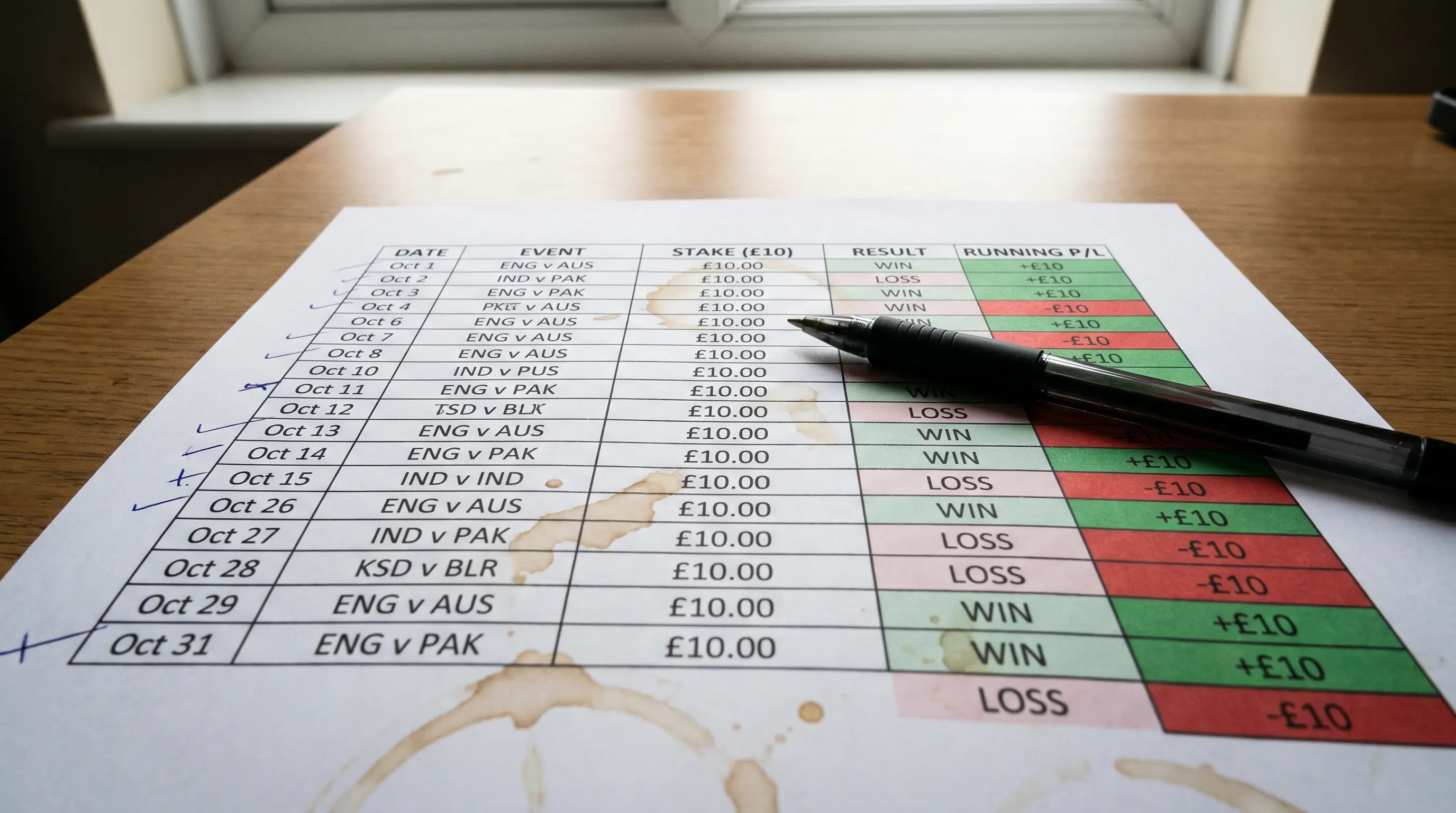
Record keeping is the habit that ties everything together. Every bet I place goes into a spreadsheet with the date, match, market, odds, stake, result, and a one-sentence rationale. At the end of each month I review the data, calculate my return on investment by market type and format, and identify patterns. Am I consistently profitable on T20 over/unders but losing on Test match winners? The numbers tell me where to focus and where to stop. Finding genuine value is only half the battle — managing your bankroll so that you survive long enough to realise that value is the other half.

Articles
Published by the cricketbettipsonline.com team.
