

Live Cricket Betting Is the Market’s Fastest-Growing Segment — Here’s How to Use It
The match that made me a live-betting convert was a T20 international at Cardiff in 2019. The batting side lost two wickets in the powerplay, and the pre-match favourite’s odds drifted from 1.55 to 2.30 in eleven deliveries. I knew the incoming batter was a proven finisher with a strike rate above 160 in middle overs, and the pitch was flat enough to allow recovery. I backed the struggling side at 2.30. They won by four wickets with an over to spare. That single in-play wager returned more than my entire pre-match portfolio for the week.
Live cricket betting — also called in-play betting — is the fastest-growing segment of the cricket wagering market, expanding at a compound annual growth rate of 11.9%. The growth is not surprising. Cricket is uniquely suited to live wagering because the sport unfolds in discrete, measurable units — deliveries, overs, partnerships — each of which produces data that shifts probability in real time. A football match can drift through twenty minutes of midfield passing with no meaningful change in state. A cricket match produces a potentially decisive event every six seconds.
I now allocate roughly 40% of my weekly cricket bankroll to live positions. That allocation has grown steadily over the past five years as I have developed a sharper eye for the moments where in-play odds misprice what is actually happening on the field. This guide is the distillation of that experience: how live cricket betting works, where the opportunities cluster by format, and how to maintain the discipline that prevents live betting from becoming reactive gambling.
How In-Play Cricket Betting Works
If you have ever refreshed a betting app mid-match and noticed the odds flickering, you have seen the live-betting engine at work. Behind that flickering is a real-time algorithm that ingests ball-by-ball data — runs scored, wickets fallen, extras conceded, run rate required — and recalculates probabilities after every delivery. The price you see is not a human opinion updated between overs. It is a machine recalibrating six times per over, every over, for the duration of the match.
The scale of this machinery is enormous. Online betting accounts for roughly 75% of the total global sports wagering market, and in the UK specifically, the online channel captured 78.47% of all sports betting revenue in 2024. The infrastructure that supports those numbers — server farms, low-latency data feeds, algorithmic pricing engines — is what makes live cricket betting possible at the granularity it now offers. Twenty years ago, you could bet on the match winner during a rain delay. Today you can bet on the outcome of the next delivery.
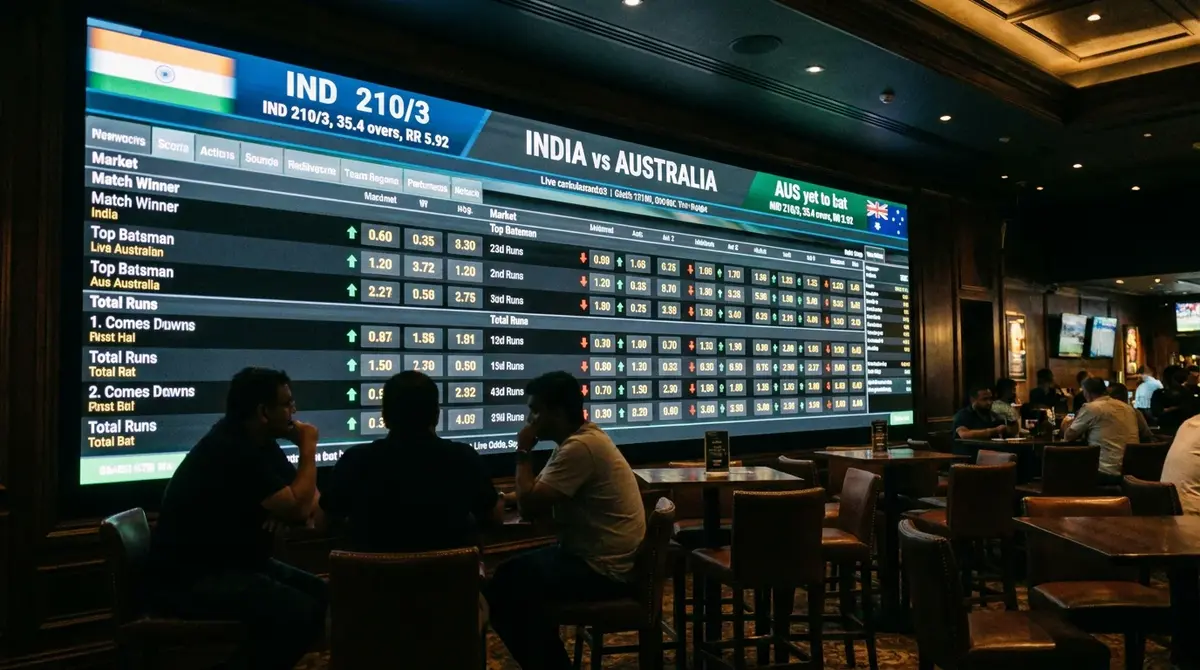
Understanding what drives in-play price movement is the first skill any live bettor needs to develop. Wickets produce the sharpest swings: when a set batter is dismissed, the batting team’s win probability drops and the odds lengthen, often by 20-30% within seconds. Boundaries produce smaller but still visible shifts, particularly in T20s where the required run rate is the primary tension. Dot balls accumulate pressure quietly — five consecutive dots in a T20 death over can shift the odds more than a single four, because the run rate climbs while the batting side’s resources shrink.
Andrew Rhodes, CEO of the UK Gambling Commission, has described the modern regulatory expectation: operators of any real size and scale that do not have well-developed algorithms, policies, procedures, interactions, and interventions in place are increasingly outliers. That statement reflects the sophistication now embedded in live-betting platforms. The algorithms that price in-play markets are not simple — they incorporate historical scoring patterns, venue data, player-specific run rates, and even weather updates. Beating them requires a different kind of edge than pre-match analysis provides.
Where the human bettor still holds an advantage is in reading context that algorithms struggle to quantify. A batter who survives a dropped catch at mid-off looks the same in the data feed as one who played and missed — both register as a dot ball. But the human watching the match knows the batter is rattled, or alternatively, knows the fielder’s error has given the batter a reprieve that will boost his confidence. Body language, crowd energy, and the visible condition of the ball are all inputs that a screen-watching bettor processes but an algorithm cannot. That qualitative edge is the foundation of everything I do in-play.
Live Markets Across T20, ODI, and Test
With 290 million online bets placed monthly on real sporting events in the UK alone, the sheer volume of wagering activity means that live markets have evolved well beyond the simple “who will win” question. Each cricket format generates its own ecosystem of in-play opportunities, and treating them identically is a fast track to inconsistent results.
T20 live markets are the most liquid and the most volatile. A standard T20 in-play menu includes next-over runs, next-wicket method, innings total runs, highest individual score, and — increasingly — next-ball outcome. The volatility comes from the format’s compressed timeline: forty overs total means each delivery represents a larger percentage of the match than in any other format. I focus my T20 live betting on two specific windows: the powerplay transition (overs 6-8, where the field spreads and scoring patterns change) and the death overs (overs 16-20, where run rates spike and wickets cluster). These windows produce the most pronounced mispricings because the algorithmic models struggle with the abrupt tactical shifts that occur at those boundaries.
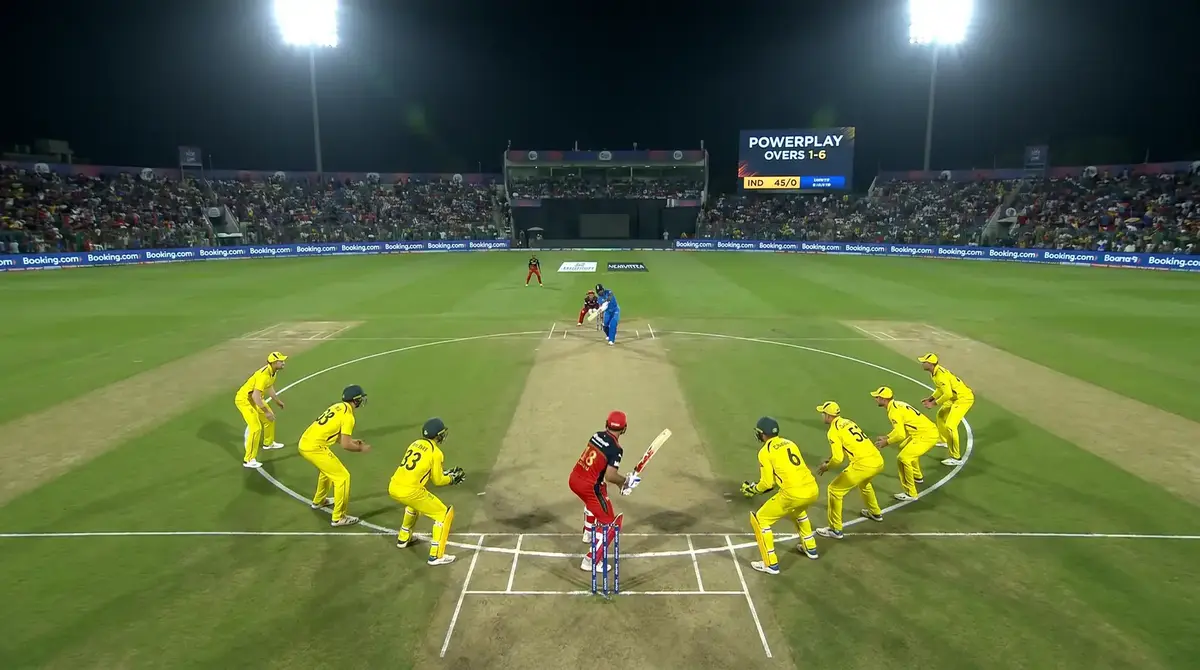
ODI live markets offer a different rhythm. The fifty-over format has three distinct phases — powerplay, middle overs, and death — and the transitions between them create betting windows that are more predictable but less dramatic than T20 equivalents. My primary ODI live play is the innings total runs market, which I enter at the end of the first batting powerplay. By over ten, I have enough data to assess the pitch, the bowling quality, and the batting approach. If the scoring rate in the first ten overs is significantly above or below the ground’s historical average, the live runs line is likely to lag the adjustment. That lag is my entry point.
My secondary ODI live market is the partnership runs market, available at most major bookmakers. Partnership bets reward pattern recognition: a batter who has just reached a fifty is statistically more likely to convert it into a big score than one who has just arrived. If the set batter is facing a bowling change with a new, less threatening bowler, the conditions for a high partnership are in place. I back the over on partnership runs in those scenarios, particularly in the middle overs where established batters accelerate.
Test match live betting is the most underexplored and, in my experience, the most profitable per-unit-staked. Test markets include session runs, next-wicket-fall over, match result (updated continuously across five days), and draw probability. The draw market is where I find the most consistent value in live Test betting. After the first innings, if the match situation is roughly even and the pitch is not deteriorating rapidly, the draw probability is often underpriced because recreational bettors overwhelmingly back decisive outcomes. I exploit this by laying both teams on the exchange or backing the draw at inflated odds, then closing the position when the price contracts — usually after a dull second-day morning session where nothing happens and the draw becomes the market favourite.
Across all three formats, one principle holds: the best live bets come from watching the match, not from staring at the odds. If you are placing in-play wagers based solely on price movements without understanding what caused them, you are trading noise rather than signal.
Reading Momentum Shifts During Play
Momentum is the most overused word in cricket commentary and the most underspecified concept in cricket betting. Every pundit talks about it; almost nobody defines it. For my purposes, momentum is a measurable shift in the probability of a match outcome driven by a cluster of events occurring within a compressed timeframe. Three wickets in two overs is momentum. A single boundary is not.
I classify momentum shifts into three tiers based on their likely impact on the live odds and, more importantly, their likely persistence. Tier one shifts are structural: the fall of a set batter who has scored more than 40% of the team’s runs, or the introduction of a specialist death bowler who has been held back. These shifts reflect a genuine change in the match’s competitive balance and tend to persist. When I spot a tier-one shift, I act quickly because the algorithms will reprice within two to three deliveries.
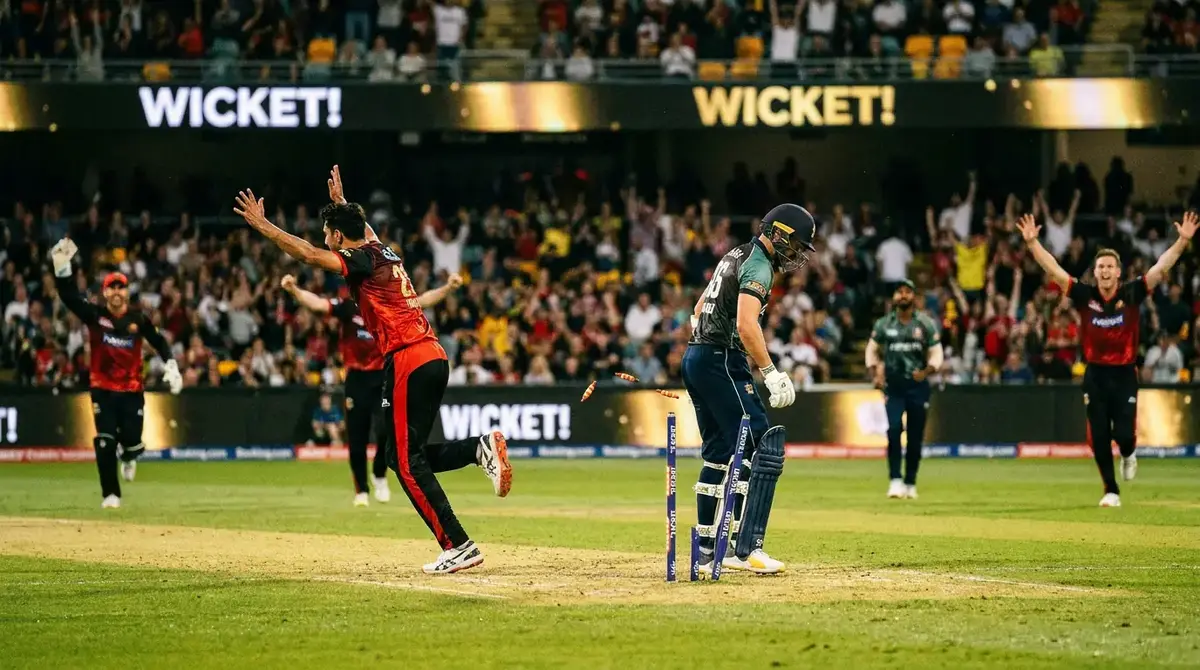
Tier two shifts are tactical: a bowling change that disrupts the batter’s rhythm, a fielding adjustment that blocks a favourite scoring zone, or a switch from pace to spin that the current batter historically struggles against. Tactical shifts are real but temporary — the batter adjusts, the captain rotates bowlers again, or the field changes. I use tier-two shifts for short-term positions, typically backing the next-over-under market or the next-wicket market, but I do not reposition my match-winner view based on tactical adjustments alone.
Tier three shifts are emotional: crowd noise, on-field verbal exchanges, a controversial umpiring decision, or a near-miss run-out that rattles the batting side. These shifts dominate the live-betting behaviour of recreational punters, who overreact to drama and underreact to data. Emotional momentum is noise, not signal. When the crowd roars after a close lbw appeal and the odds spike momentarily, that is my cue to take the other side if the fundamentals have not changed. The algorithm will correct within an over, and the price will revert.
In T20 cricket, where teams batting second win roughly 53-55% of the time, the most important momentum point is the innings break. The chasing team knows the target. They know the pitch. They know which bowlers the opposition has used and which are fresh. That informational clarity is a structural advantage, and it is often underpriced in the first two or three overs of the chase before the market adjusts to the specific batter-versus-bowler matchup data. I frequently enter a live position backing the chasing side at the start of the second innings if the required rate is below eight per over in a T20 — a target that history suggests is achievable more often than the pre-chase odds imply.
Reading momentum is ultimately about distinguishing between what has changed and what merely looks like it has changed. If you react to every roar from the crowd, you will churn through your bankroll in a session. If you wait for structural shifts and ignore the noise, you will be positioned correctly when the market catches up.
Timing Your Live Cricket Bets: Key Intervals
Timing in live cricket betting is not about placing bets faster than the algorithm — you will lose that race every time. Timing is about knowing when the gap between the algorithm’s assessment and reality is widest, and positioning yourself before the gap closes.
The powerplay is the first and most predictable timing window. In T20s, the mandatory fielding restrictions during the first six overs create a scoring environment that differs fundamentally from the middle and death phases. A team that reaches 55-1 after the powerplay is in a different position than one at 35-3, yet the live odds sometimes fail to distinguish between a high-quality 55-1 built against good bowling and an unsustainable 55-1 built on dropped catches and miscued boundaries that fell safely. I watch the quality of the runs — how many were from the middle of the bat, how many edges, how many mishits that cleared the field — and adjust my assessment of sustainability accordingly. If you are interested in a deeper breakdown of how powerplay betting in cricket works across different leagues and conditions, I have dedicated an entire guide to that phase.
The second timing window is the innings break, which I touched on in the momentum section. In T20 and ODI matches, the ten-to-twenty-minute gap between innings is the single longest pause in algorithmic repricing. The market for the second innings is set based on the first-innings total, but it does not yet account for the specific tactical adjustments the chasing side will make. If the chasing captain sends out a pinch-hitter instead of the usual opener, or promotes a left-hander to counter the opposition’s right-arm seamers, those changes are visible on the team sheet but not yet priced. I use the innings break to prepare my second-innings position and execute it within the first two overs of the chase.
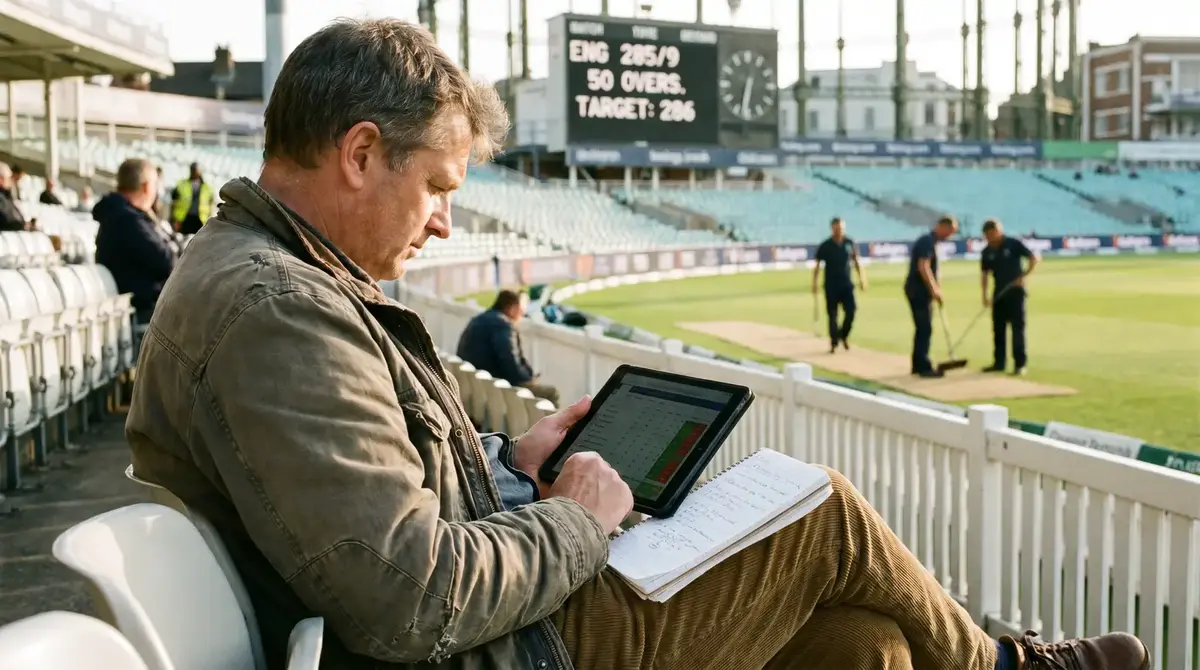
The third window is the middle-overs lull in ODIs and the consolidation phase in Tests — periods where very little happens, run rates slow, and live odds barely move. Recreational bettors lose interest during these phases, which means liquidity drops and prices become slightly less efficient. I place my highest-conviction Test bets during the second session of a day’s play, when the market is quietest and the odds on outcomes like the draw or the session-runs under are often generous because nobody is watching closely.
One window I deliberately avoid is the final over of a T20 innings when the match is in the balance. The odds are extremely volatile, the margin for error on both sides is minimal, and the outcome hinges on a handful of deliveries that are essentially coin flips at that point. I have tried to trade the final over profitably and the data from my betting log is unambiguous: my strike rate in last-over positions is below 40%. I leave that market to the gamblers and preserve my bankroll for higher-probability spots.
Managing Risk and Discipline In-Play
Here is the honest truth about live cricket betting: it is harder to maintain discipline in-play than pre-match, and anyone who tells you otherwise has not done enough of it. The immediacy of a live match creates an emotional pull that pre-match analysis does not. You watch a catch get dropped, you see an opportunity, and the urge to act is physical. The live segment is expanding faster than any other corner of cricket wagering, which means more people are experiencing that pull than ever before, and most of them are giving in to it.
My discipline framework for live betting rests on three rules that I never break, no matter what is happening on the field.
The first rule is a session budget. Before I open the betting app for a match, I decide the maximum amount I will risk across all in-play positions for that session. Typically, it is 5% of my weekly bankroll. Once that limit is reached — whether through losses, outstanding positions, or a combination — I close the app and watch the rest of the match as a spectator. The temptation to reload is strongest after a loss, which is exactly why the budget must be non-negotiable.

The second rule is a mandatory pause between bets. I wait a minimum of two overs between placing one live bet and placing the next. This rule exists to prevent the “cascade” problem, where one impulsive bet leads to a correction bet, which leads to a hedging bet, which leads to a panic bet. Each of those bets carries a margin cost, and after four, you have effectively donated several percentage points of your bankroll to the bookmaker for the privilege of managing your own anxiety. Two overs of enforced patience interrupts the cascade before it starts.
The third rule is to never add to a losing position unless the match conditions have structurally changed. If I have backed a team to win and they lose two quick wickets, I do not double down at the longer odds just because the price looks attractive. I only add to the position if my analysis of the new situation — the specific batter coming in, the remaining bowling resources, the state of the pitch — genuinely supports it. “The odds are longer” is not an analysis. It is a justification dressed up as strategy.
Live betting rewards patience far more generously than it rewards speed. The best in-play bettors I have encountered are not the quickest to act — they are the most willing to wait.
Tools and Platforms for Live Cricket Betting
You do not need expensive software to bet on live cricket effectively, but you do need the right combination of free tools running simultaneously. My live-betting setup involves three screens — or, more realistically for most people, three tabs on a laptop and the match on a television.
The first tab is the live scoring feed. I use ESPNcricinfo’s ball-by-ball commentary or the equivalent on the ICC’s official platform. These feeds update faster than television broadcasts by roughly five to eight seconds, which means the text commentary tells me about a wicket before I see it on screen. That gap matters because bookmakers suspend markets within one to two seconds of a wicket, and if I am relying on the TV broadcast alone, the market is already closed by the time I react. I never place a live bet based on the TV feed — I use the scoring feed for data and the TV for context.
The second tab is the odds comparison tool. I want to see the live prices from multiple bookmakers simultaneously, because in-play odds can diverge by five to ten ticks between platforms during fast-moving passages. Aggregator sites display live odds from several UK-licensed operators side by side, and the price difference between the best and worst offering on a given market frequently exceeds the margin I am trying to capture. If I am going to back a team at 2.20, I want to confirm that 2.20 is the best available price, not a lazily accepted one.
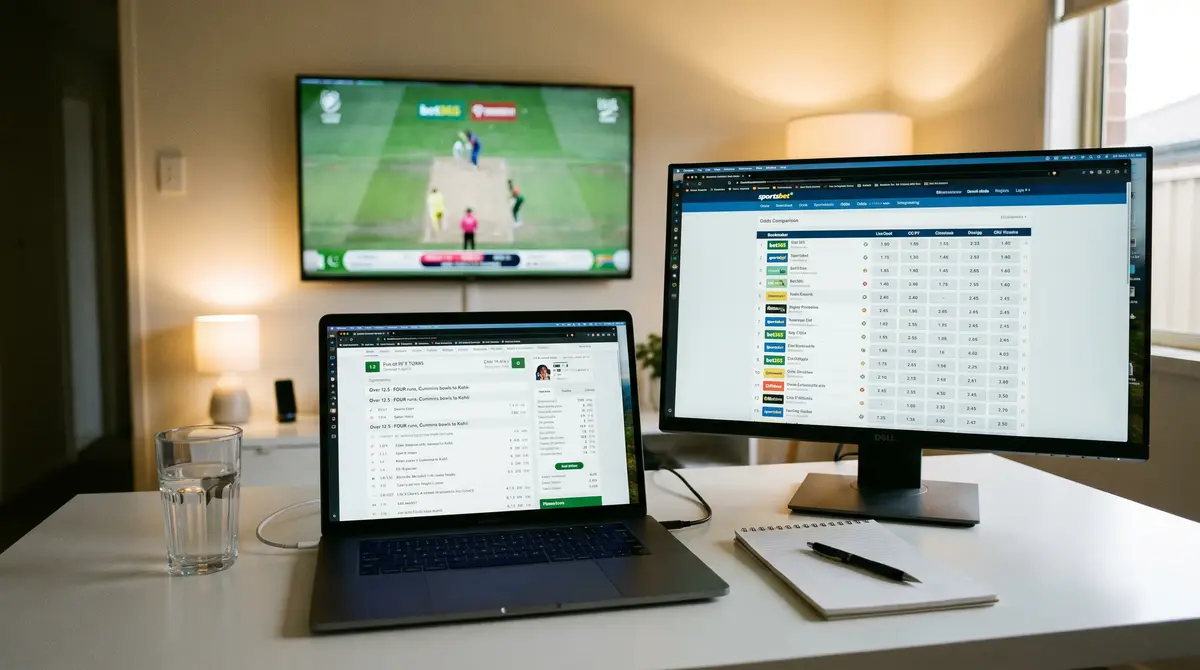
The third tab is my own match tracker — a simple spreadsheet where I log deliveries, wickets, and my running probability estimate for the match-winner market. I update this every two overs. The discipline of maintaining my own probability estimate, independent of the bookmaker’s price, prevents me from anchoring to the market. When my number diverges from the market’s number by more than five percentage points, I have a potential trade. When they converge, I stay out.
Platform quality varies significantly. The two largest UK operators account for over half of all paid search clicks in the sports betting space, which reflects their market dominance but not necessarily their live-betting product quality. I evaluate platforms specifically on three criteria for in-play cricket: the speed of odds updates, the depth of live markets available, and the reliability of the cash-out function. A platform that offers twenty live markets but suspends half of them during fast-moving passages is less useful than one offering ten markets that remain consistently available. Test platforms with small stakes during meaningless group-stage matches before committing real capital during high-stakes fixtures.
Live Cricket Betting — Common Questions
Articles
Published by the cricketbettipsonline.com team.
